Loading
.
.
.
A circular business model that maximizes the value of rare metals
By combining advanced processing and recycling technologies, Furuya Metal maximizes the value of precious metal resources. This integrated approach supports a circular business model in which materials are recovered, reused, and returned to the production cycle.

Recyclable materials contain a wide variety of shapes and compositions. They are first crushed and thoroughly mixed to achieve a more uniform condition. This enables more efficient processing in the subsequent stages.
Furuya Metal recovers not only spent products, scrap materials, and electrodes collected from customers, but also the smallest particles adhering to wipes and gloves used during manufacturing processes. This comprehensive approach to recycling is one of the company's key strengths.
It is not practical to analyze every piece of recycled material. Instead, samples are taken from the mixed material and analyzed to determine the content of metals such as iridium and ruthenium. This data is essential for accurate recovery and refining.
As a core technology underpinning the quality assurance of precious metal products, Furuya Metal has established analytical capabilities that can detect trace impurities at the ppb (parts-per-billion) level. By utilizing advanced analytical instruments such as ICP-OES (Inductively Coupled Plasma Optical Emission Spectrometry) and GD-MS (Glow Discharge Mass Spectrometry), the company performs trace elemental analysis for nearly all elements in the periodic table.
These capabilities not only provide scientific verification of product purity but also enable traceability and environmental impact assessment.
Recycled materials are melted at high temperatures to facilitate the separation and recovery of metals such as iridium and ruthenium. This process enables large-scale processing of recycled materials.
The Tsuchiura Plant serves as one of Japan's leading recycling centers for precious metals. The facility carries out the refining and recovery of iridium and ruthenium. For ruthenium, the plant has the world's largest annual refining and recycling capacity of 25–30 tonnes.
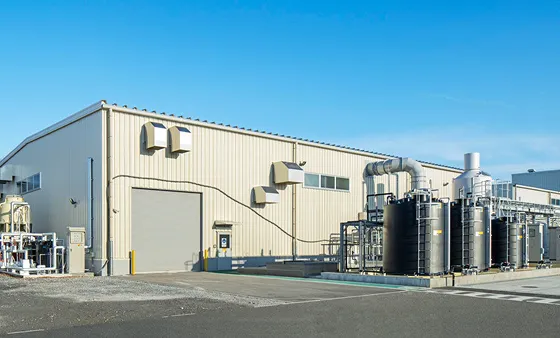
In this process, iridium and ruthenium are precisely separated and recovered from the molten material. Only at this stage are these metals returned to the resource cycle.
Iridium and ruthenium are extremely rare metals. Iridium, in particular, is traded at approximately $7,600 per toz, making it more valuable than gold.
*Gold: approximately $4,608 per toz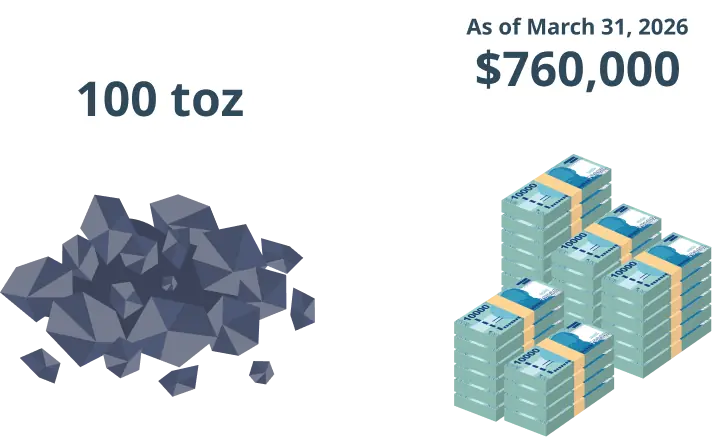
Through advanced recycling technologies, Furuya Metal is able to recover iridium and ruthenium from spent products and refine them to a purity of 99.999%. This capability enables the effective use of scarce precious metal resources while reducing environmental impact.