Powder Sputtering
Thin-Film Coatings That
Give Materials New Functions
Powder sputtering technology imparts new functionalities to powder materials, including electrical conductivity, optical properties, protective and barrier coatings, and enhanced hardness. By forming uniform, high-purity nanometer-scale thin films on powder surfaces, it enables precise control of material properties that would be difficult to achieve through conventional processing methods.
Moreover, the technology can be applied not only to spherical particles but also to materials with complex geometries, expanding the possibilities for advanced material development in semiconductors and other cutting-edge fields.
What is powder sputtering?
What is sputtering?
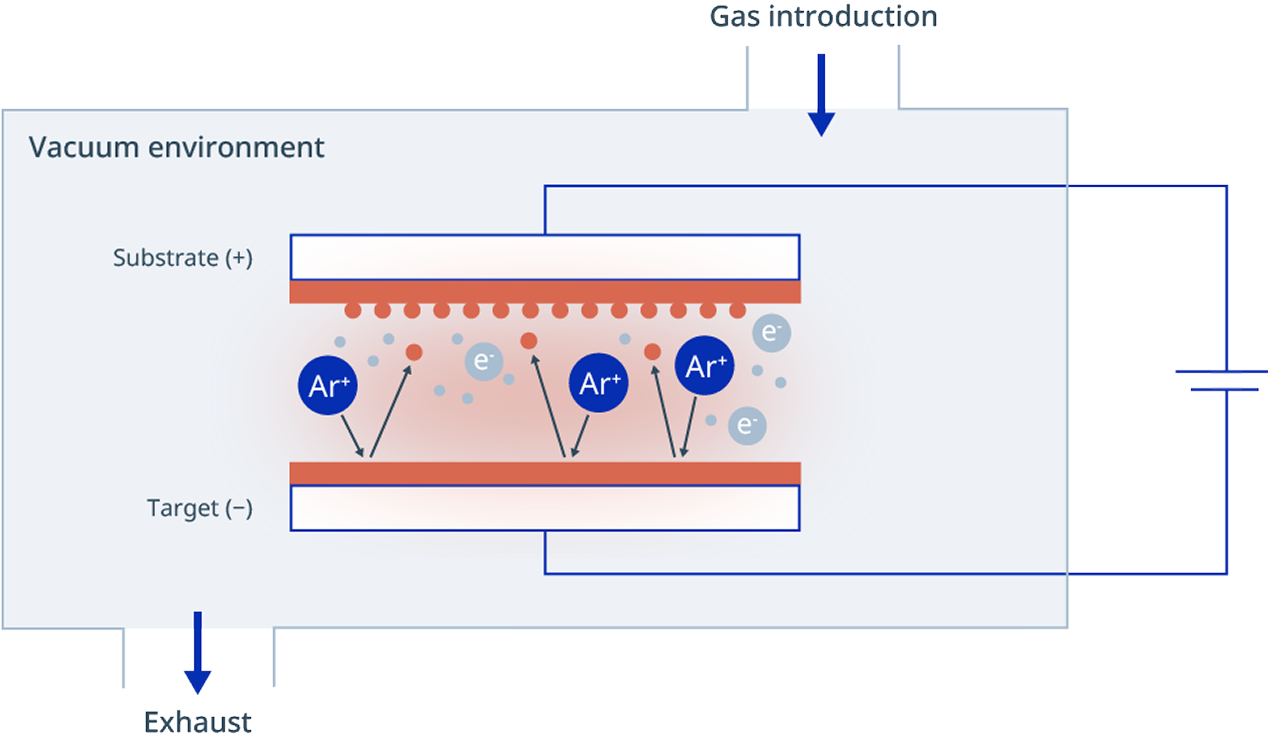
Sputtering is a thin-film deposition process that utilizes plasma. In a vacuum environment, a noble gas is ionized to generate plasma, and the resulting ions collide with a target that serves as the film-forming material. Atoms and molecules ejected from the target surface are then deposited to form a thin film.
Principle of sputtering
Sputtering in coating technologies
Advantages of sputtering for powder materials
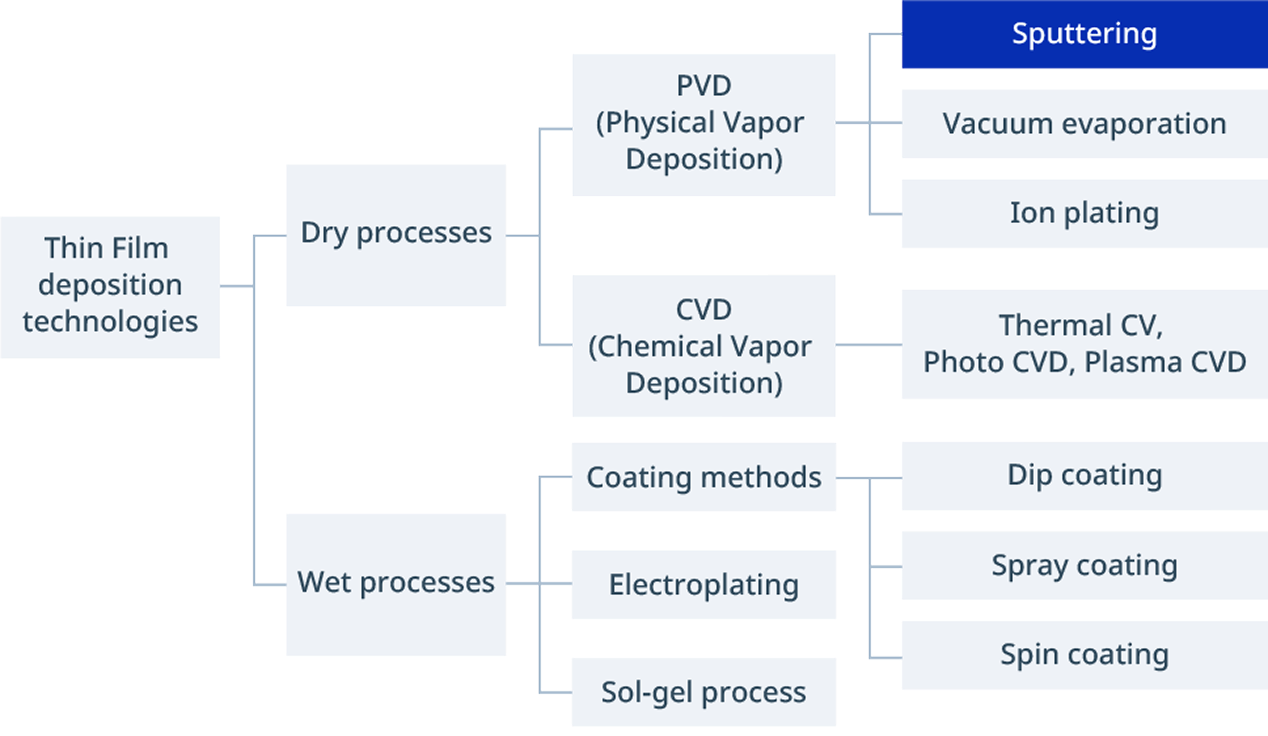
Sputtering is one of the most versatile coating methods within the PVD (Physical Vapor Deposition) family, capable of forming thin films from a wide range of materials. Although sputtering is often regarded as having a lower deposition rate than processes such as vacuum evaporation, it offers the advantage of producing dense and highly uniform thin films.
When considering the combined functionality of powder materials and thin films, the ability to form thin films from a wide variety of materials makes sputtering particularly well suited to such applications.
Please feel free to contact Furuya Metal.
Functionalities

Electrical properties
By applying metallic coatings to non-conductive materials such as polymers, ceramics, and glass, these materials can be utilized as electrically conductive materials.
- Imparts electrical conductivity to insulating materials such as polymers, ceramics, and glass.
- Forms insulating films on electrically conductive materials such as metals.
- Enhances electrical conductivity and thermal conductivity, thereby improving heat dissipation performance.

Optical properties (reflectivity and transmittance)
Decorative materials with enhanced visual appeal can be created by utilizing the color characteristics of thin films. In addition, multilayer thin-film structures can be employed to explore and achieve various optical effects.
- Enhances transmittance by forming a low-refractive-index coating on the surface of a high-refractive-index material.
- Enhances reflectivity by forming a high-refractive-index coating on a low-refractive-index transparent material.
- Enhances reflectivity by depositing a metallic film on a transparent material.
- Forms optical thin films through the deposition of multilayer coatings on transparent materials.
- Enables the combination of electrical and optical properties, such as enhancing electrical conductivity while maintaining transparency.

Barrier Performance
Barrier films can be formed to prevent the leaching of material constituents and to inhibit the penetration of external solvents and gases.
- Barrier films can help suppress the leaching of material constituents when they are susceptible to dissolution by solvents.
- Barrier films can help prevent the penetration of solvents into the material.

Metal loading technology
Metal particles can be deposited as island-like structures, similar to conventional wet-process loading techniques.

Adhesion Performance
Forms adhesion-promoting layers for materials with poor adhesion properties.
- Improves adhesion performance by forming adhesion-promoting layers on materials with poor adhesion properties.
Dry pretreatment of powders for improved film quality
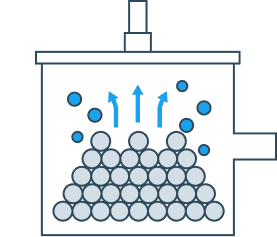
Thermal degassing

Surface modification
(formation of an underlayer)
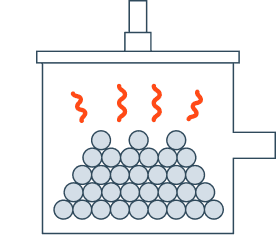
Vacuum degassing
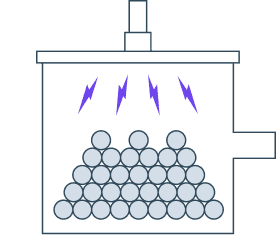
Plasma ashing
Applications and industries
| Example applications | Functionality | Thin-film materials | Notes |
|---|---|---|---|
| Electronic components |
Magnetic properties (motors) | Fe、Co、Ni | Enhanced magnetic performance |
| Heat dissipation (heat sinks) | Ti、Cu、etc. | Effective in mitigating thermal runaway associated with the miniaturization of integrated circuits | |
| Ball Grid Arrays (BGAs) | Au、Ag、Cu、Sn、etc. | Thin-film deposition on resin balls | |
| Conductive pastes | APC、Ag、Al、etc. | Maintains functionality while reducing costs | |
| Quartz devices | Ni and other metals | Enables precision processing of brazing materials | |
| Sensors | APC、Ni、etc. | Optical sensing applications around 900 nm | |
| Catalysts | Methanation | Ru、Ni、etc. | Applicable to a wide range of catalyst-related materials. Strong demand is currently seen for methanation and CO₂ conversion applications. |
| FT catalysts and CO₂ conversion | Ru、Cu、Ni、etc. | ||
| Three-way catalysts | Ni、Pd、Ru、etc. | ||
| Platinum catalysts | Pt | ||
| Aesthetic properties |
Functional coatings | Various metals and metal oxides | Functional coatings utilizing wavelength-dependent optical interference |
| Cosmetics | APC、etc. | Enhanced reflectivity at specific wavelengths while maintaining transparency in the visible spectrum | |
| Batteries | All-solid-state rechargeable batteries (current collectors) | Li-based thin films, etc. | Formation of current collectors on fine powder powders |
| Grinding and cutting |
Abrasives | Ti、Cu、W、etc. | Polishing of hard materials and final polishing applications |
| Barrier films | Various barrier applications (including batteries) | Various metals and metal oxides | Barrier protection against H₂O, O₂, N₂, and other species to preserve powder functionality |
| Specialized functionalities |
Hydrogen storage | Pd、Pd-Ag、etc. | Fabrication of thin-film hydrogen storage layers |
Please feel free to contact Furuya Metal.
Furuya Metal’s strengths
Achieving film quality and productivity beyond conventional powder sputtering
Furuya Metal has more than 20 years of experience in powder coating. In the early stages, conventional barrel-based deposition processes were employed; however, challenges remained in achieving uniform film quality and high productivity.
Today, leveraging its proprietary powder-processing technologies, Furuya Metal has established a coating process capable of handling powders regardless of particle shape while delivering high film uniformity, excellent reproducibility, and high material recovery rates.
Strengths behind Furuya Metal’s powder sputtering technology
- Uniform thin-film coating with minimal variation, even on fine powders
- Compatible with non-spherical particle shapes
- From prototyping to mass production
- Extensive materials expertise
- Compatible with fragile powders and substrates prone to wear or damage
- High powder recovery rates
- Development support available
- Decades of experience and accumulated know-how
Powder sputtering capabilities

Example of film formation
Continuous film: Coating the outer surface of powder particles
- Film deposited on 3 μm powder particles
- Si thin film, 5–7 nm thick
- Uniform thin-film formation confirmed by EDS mapping
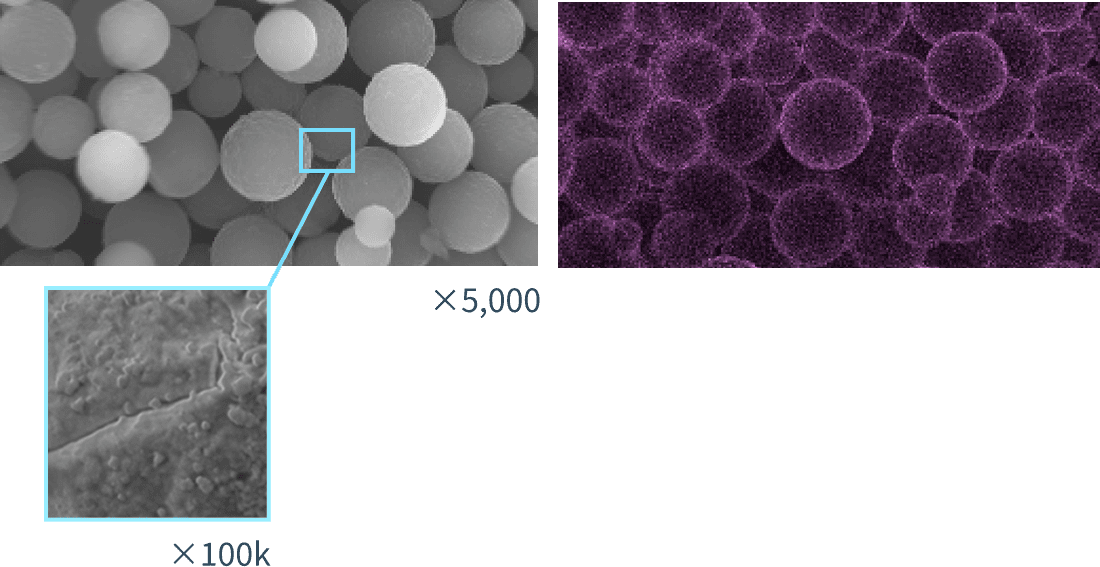
Example of film formation
Island structure: Discrete island-like coating on powder surfaces
- Film deposited on 500 nm powder particles
- Ru thin film, 2 wt% loading
- Beyond the resolution limit of EDS analysis
- Island formation confirmed by TEM imaging
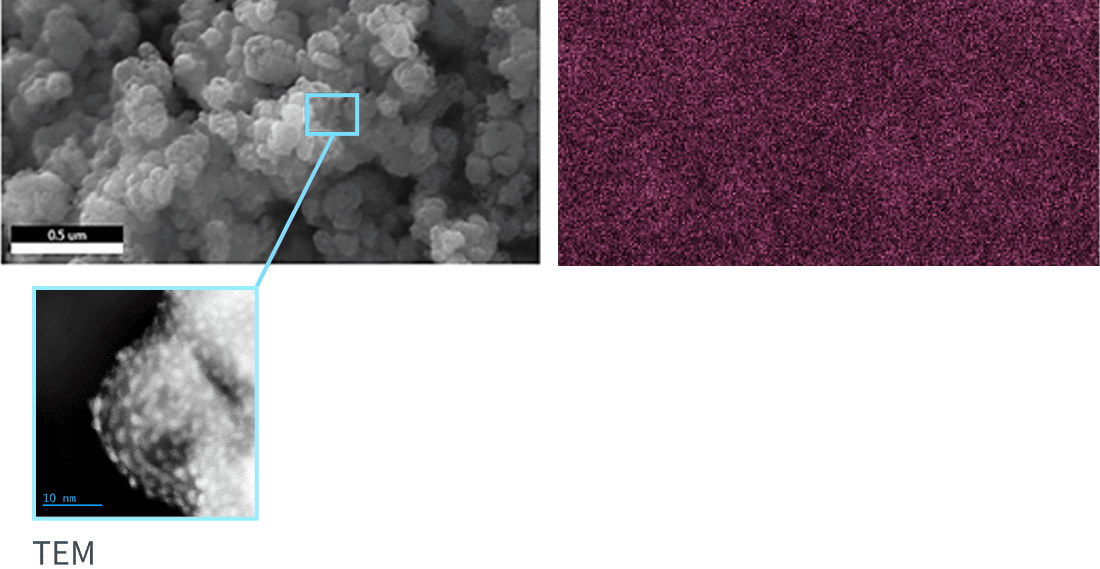
Powder sputtering processing capacity for prototyping and scale-up evaluation
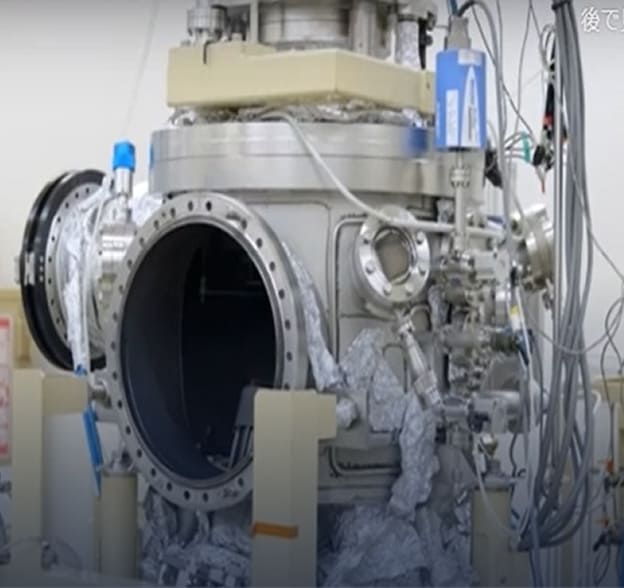
Furuya Metal offers both compact sputtering systems for prototype development and medium-scale systems designed with future mass production in mind. Both platforms are equipped with multiple cathodes, enabling not only single-layer deposition but also co-sputtering (simultaneous deposition) and multilayer film formation.
Experimental system optimized for prototype development (Mini system)
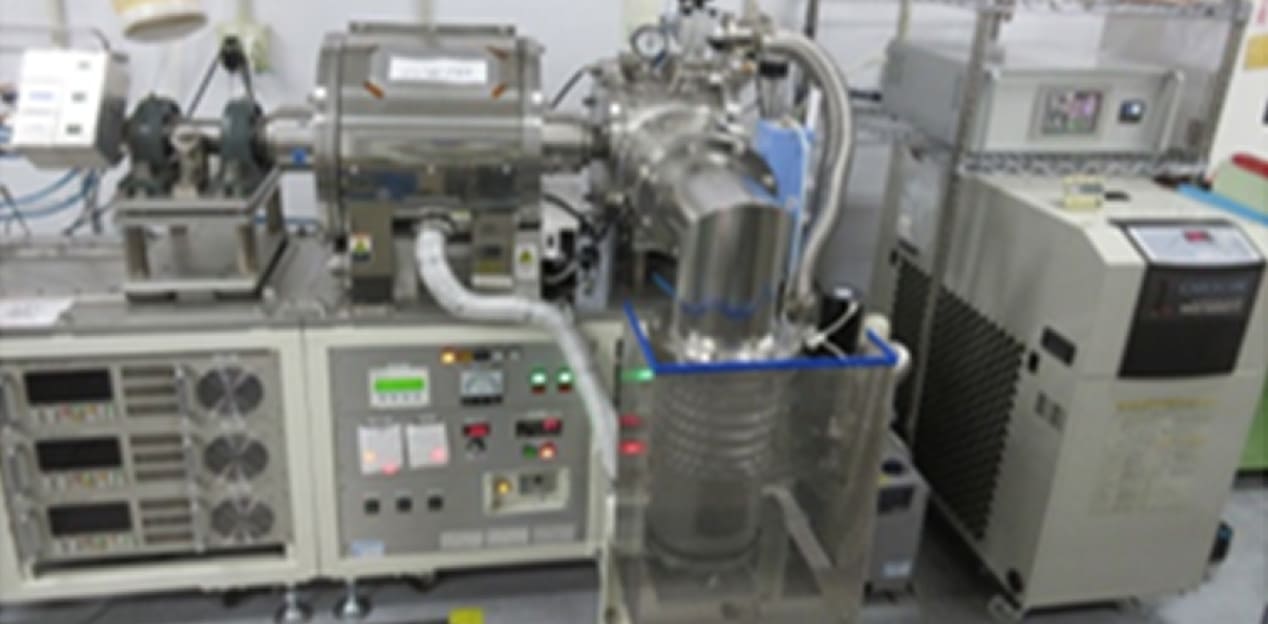
| Number of cathodes | 2 cathodes |
|---|---|
| Heating capability | Available |
| Surface treatment | Available |
| Processing volume | 5–20 cc (feed volume) |
Experimental system optimized for prototype development (Mini system)
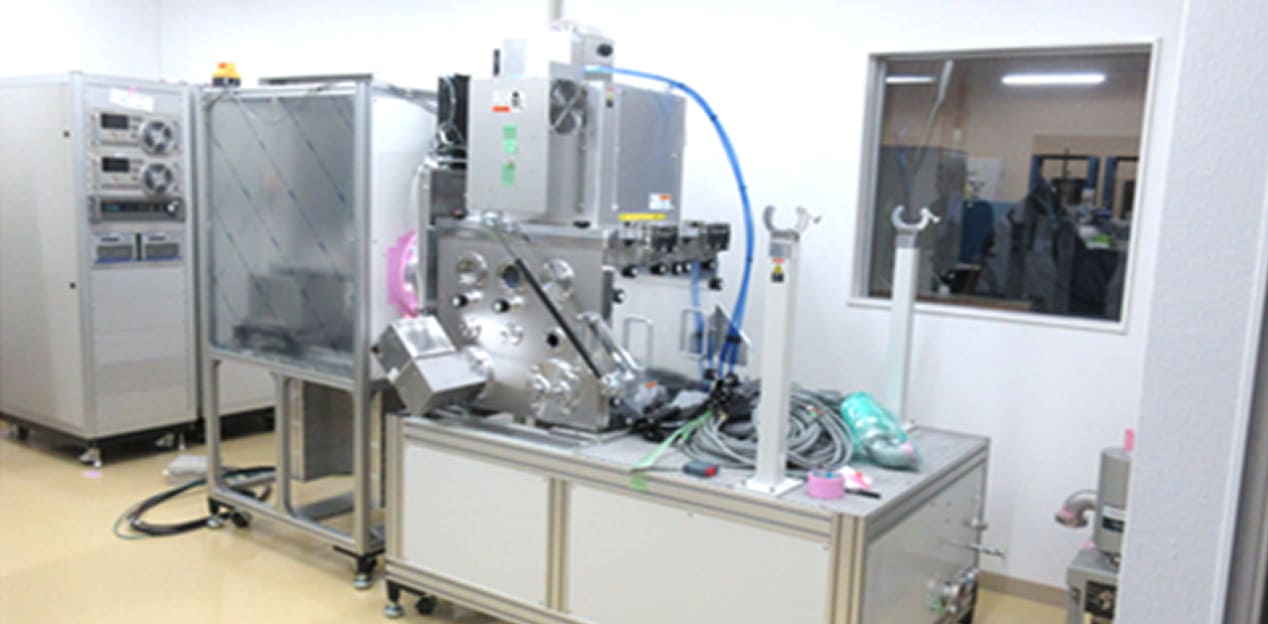
| Number of cathodes | 2 cathodes |
|---|---|
| Heating capability | Available |
| Surface treatment | Available |
| Processing volume | 100–400 cc (feed volume) |